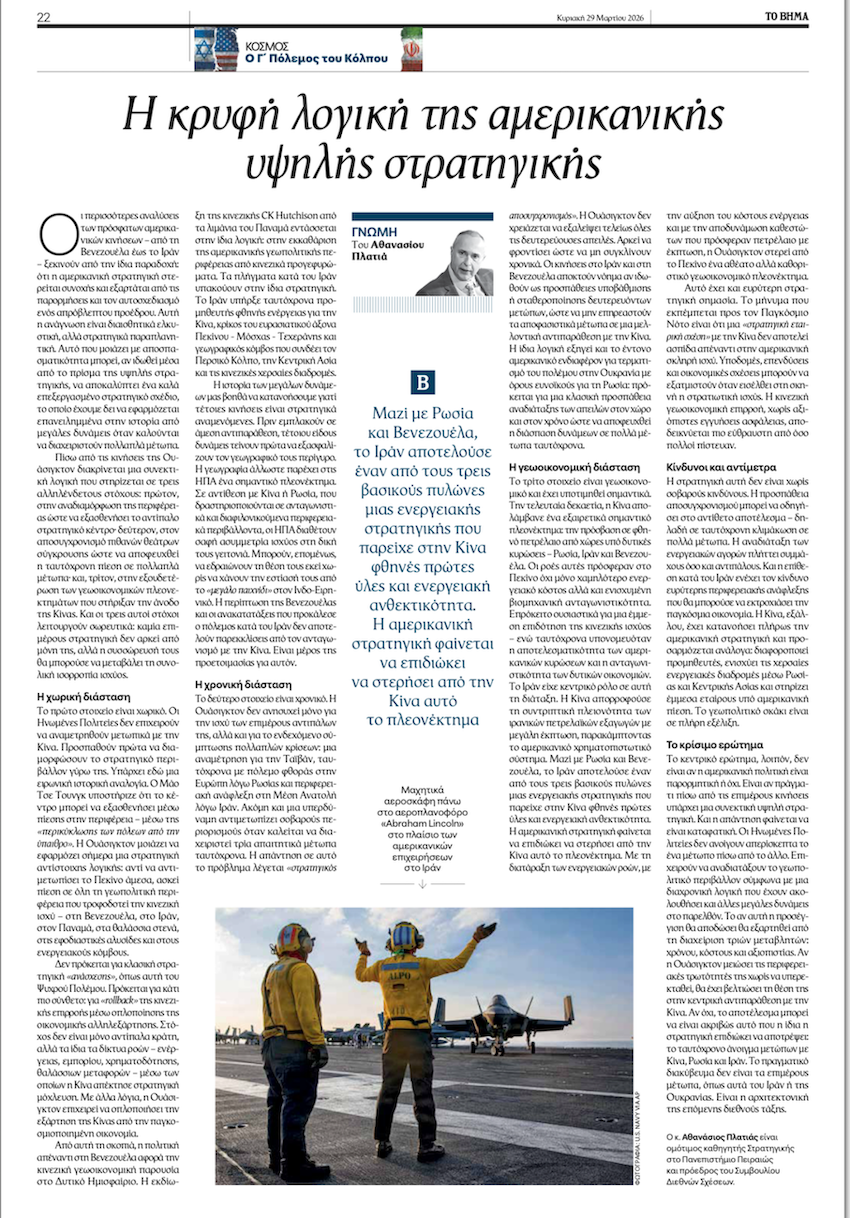
Αθ. Πλατιάς: «Η κρυφή λογική της αμερικανικής εξωτερικής πολιτικής» [Το ΒΗΜΑ, 29/2/2026]
Disclaimer: All opinions and arguments expressed by CFIR-GR are personal and do not necessarily reflect those of the organization.
The de facto closure of the Strait of Hormuz is not merely another oil shock. It is a structural rupture in the global energy system—arguably the most severe in modern history.
The de facto closure of the Strait of Hormuz is not merely another oil shock. It is a structural rupture in the global energy system—arguably the most severe in modern history. The head of the International Energy Agency has described it as “the greatest global energy security challenge in history,” warning that restoring normal flows could take six months or longer. That assessment reflects a simple reality: when a chokepoint carrying roughly a fifth of the world’s oil and around a fifth of global LNG is disrupted, the consequences are systemic, not cyclical.
Unlike previous energy crises, this one is not driven by market imbalances or political embargoes. It is driven by the physical disruption of infrastructure and maritime routes. When a chokepoint closes, the market does not simply reprice risk. It redistributes power.
The immediate effect is fragmentation. The global energy market splits into two partially disconnected systems: one centered on the Gulf, where supply is stranded or severely constrained, and another centered on the Atlantic Basin, where supply remains deliverable. Prices no longer move uniformly. Gulf-origin grades have surged to extraordinary levels, reflecting acute scarcity where the disruption is most severe, while Atlantic Basin benchmarks tell only part of the story. At the heart of this reordering lies a fundamental principle: in a chokepoint crisis, the decisive variable is not who produces energy, but who can deliver it. Accessibility, not abundance, determines advantage.
A Shock That Points East
In economic terms, the Strait of Hormuz points east. In 2024, 84 percent of crude oil and condensate flowing through the strait was destined for Asian markets. China, India, Japan, and South Korea together accounted for approximately 70 percent of all Hormuz crude flows. This is where the disruption is felt most immediately and most intensely.
The consequences are already visible. Japan and South Korea maintain extensive strategic petroleum reserves but are acutely vulnerable to spot market volatility. Their technology-heavy economies are already under strain. India faces a particularly severe dual shock: more than 60 percent of its oil imports originate from the Middle East, while Qatar and the UAE account for 53 percent of its LNG imports. A Hormuz-driven crude spike simultaneously raises oil import costs and LNG contract prices indexed to Brent.
The macroeconomic risk is considerable. The Dallas Federal Reserve estimates that a single quarter of Hormuz closure removing close to 20 percent of global oil supply could lower global real GDP growth by an annualized 2.9 percentage points. Energy is a universal input. The Hormuz crisis therefore carries the potential to move from an energy shock to a full-scale economic downturn.
The Bypass Illusion
Much has been made of the pipeline infrastructure that Saudi Arabia and the UAE have built to circumvent Hormuz. The picture is more complicated—and more sobering—than early reports suggested.
Saudi Arabia’s East-West Petroline has a theoretical emergency capacity of around 7 million barrels per day. The UAE’s Abu Dhabi Crude Oil Pipeline adds a further 1.8 million barrels per day of capacity via Fujairah. On paper, this is substantial. In practice, the constraints are severe. While Petroline’s pipes can move up to 7 million barrels per day, the port terminals at Yanbu have an effective operational loading capacity of approximately 4 million barrels per day. Combined with Fujairah, total bypass throughput amounts to roughly 5.5 to 6 million barrels per day—against the approximately 20 to 21 million that normally transit Hormuz.
The gap—some 14 million barrels per day—cannot be bridged by existing infrastructure. Iraq, Kuwait, and Qatar have no functioning bypass. Iraqi crude from the Basra terminal complex is effectively stranded. Kuwait’s production is landlocked. Worse, Iran has not simply closed Hormuz and waited. It has moved immediately against the exit ramps—the ports and terminals that bypass pipelines depend on to get oil onto tankers. Iranian drone strikes on Fujairah and Yanbu have demonstrated that even bypass infrastructure is exposed to geopolitical risk. The Saudi workaround is a pressure valve, not a full solution. The East-West system allows the kingdom to preserve a significant share of its sales, but it cannot compensate for the massive loss of Gulf flows or remove the structural vulnerability created by the disruption of Hormuz.
Russia: From Constrained Supplier to Strategic Pivot
Russia emerges as one of the clearest beneficiaries—and the irony is stark. Western sanctions had compressed Russian fossil fuel revenues to approximately $501 million per day in January 2026. Within two weeks of the US-Israeli strikes on Iran, Russian daily revenues had rebounded to approximately $554 million. As Asian buyers scrambled to replace Gulf barrels, Russian crude became indispensable. In India—where Russian imports had fallen by approximately 20 percent in February—shipments surged back towards 1.8 to 2.2 million barrels per day in March.
The Trump administration compounded the reversal. Washington issued temporary sanctions waivers permitting Russian crude sales to India, China, and the United States—a de facto relaxation that Treasury Secretary Scott Bessent described as “an inevitability.” Washington was caught between two conflicting strategic imperatives: maximum pressure on Iran and the need to prevent an energy crisis from destabilizing its own allies and domestic economy. The result was an energy policy that appeared contradictory but was in fact situational: maximum pressure on Iranian oil, temporary flexibility on Russian oil.
The geopolitical implications extend far beyond price. China and India do not simply turn to Russia out of immediate necessity in a crisis—that necessity deepens their structural dependence, strengthening Moscow’s position across Eurasia. The effort to compress Russian energy revenues, painstakingly constructed over four years of sanctions architecture, is substantially eroded by the logic of scarcity. The consequences for Ukraine are direct and serious. The Kremlin’s bargaining position has materially improved.
The United States: The Advantage of the Shale Revolution
If Russia benefits from geography, the United States benefits from structural transformation. The shale revolution has turned America from the world’s largest oil importer into its largest producer and from an LNG importer into the world’s leading LNG exporter. That transformation is central to understanding the current crisis.
The United States is far less vulnerable to Gulf disruption than Asia or Europe, while simultaneously benefiting from higher prices and surging demand for its exports. As one of the world’s largest oil producers and exporters, the US can offset any decreased imports by boosting domestic shale output—though shale facilities require three to six months to meaningfully increase production, meaning strategic reserves bridge the gap in the near term.
The deeper advantage is geopolitical. Europe, already reliant on American LNG following the rupture with Russian supply, finds itself with even fewer alternatives now that Gulf LNG is stranded. The result is a tightening of transatlantic energy dependence and a corresponding increase in American leverage over European partners—at the very moment Europe is attempting to assert strategic autonomy. Canada stands to gain in similarly clear commercial terms. With production anchored in the Atlantic Basin, Canadian producers capture the upside of higher global prices without facing the logistical constraints of Gulf exporters—a windfall that gives Prime Minister Carney additional fiscal room to cushion the effects of American trade pressure. Norway, Brazil, and West African exporters benefit in analogous ways. Geography, long assumed to have been softened by globalization, reasserts itself decisively.
Europe: From Diversification to Substitution
Europe’s post-2022 energy strategy was built on one overriding objective: diversification away from Russian supply. In practice, this meant a structural shift towards American LNG and Qatari gas. The Hormuz crisis has exposed the limits of that strategy with brutal clarity. Qatar sends almost all of its LNG exports through the Strait of Hormuz. European utilities are now forced into expensive spot-market purchases from the United States or West Africa. The result is not energy independence but a reconfiguration of dependence—from Russia to the United States.
The two dependencies are not equivalent; the political context differs. But the structural vulnerability is real, and the direction of travel is uncomfortable. Europe finds itself more reliant on American energy supply at the very moment it is trying to increase its strategic autonomy from Washington. The economic consequences compound the strategic ones. Higher energy costs undermine industrial competitiveness and accelerate the risk of deindustrialization. For Europe, the Hormuz shock is as much an industrial crisis as an energy one.
China: Resilient but Structurally Weakened
China’s position is the most complex. Beijing enters the crisis with roughly six months of oil stockpiles, and its ongoing energy transition provides some structural cushion—electric vehicles are already displacing over a million barrels per day of implied domestic oil demand. Chinese-flagged vessels appear to retain some degree of preferential passage through Hormuz, suggesting Beijing has been quietly carving out a protected corridor even as Western shipping retreats.
But the medium-term picture is less comfortable. China loses access to discounted Iranian crude—the cheapest oil it had. It becomes more dependent on Russian supply, deepening an asymmetric relationship in which Russia gains leverage over its largest customer. Its LNG supply is disrupted: approximately 30 percent of China’s LNG imports come from Qatar and the UAE, both of which route entirely through Hormuz. The diversification strategy that Beijing has pursued for a decade—spreading supply across the Gulf, Russia, Africa, and Central Asia—narrows precisely when it matters most. For a state that treats energy security as a core national security priority, this is a meaningful strategic setback.
The Gulf: From Hub to Contested Zone
It is tempting to view Gulf exporters as beneficiaries of higher prices. In reality, they are among the primary losers. The critical variable is not price but deliverability. Energy installations across the region are under attack. Even where production continues, the ability to ship is constrained. Iran has been careful to target Gulf infrastructure in ways that hurt global markets without, so far, causing lasting systemic damage to Saudi Arabia itself—preserving a fragile implicit understanding while maximizing economic pressure on the West. The threat of Houthi re-entry into the conflict would mark a new and more dangerous stage.
The Gulf’s role in the global energy system is therefore transformed: from a stable hub of supply to a contested zone of production and risk. This has profound implications for the reliability that has underpinned global energy markets for half a century. The insurance and financing infrastructure that supports Gulf trade has been damaged in ways that will not quickly reverse even if the strait reopens.
A New Energy Order
The broader lesson is unmistakable. Energy security is inseparable from national security. Control over supply routes, infrastructure resilience, and source diversification are not merely economic considerations—they are strategic imperatives.
The Hormuz crisis does not simply raise prices. It reshapes the hierarchy of global energy power and accelerates trends that were already under way. Producers with accessible supply—above all the United States and Russia—gain strategic influence. Europe faces renewed structural dependence and industrial decline. Asia bears the brunt of the immediate shock. The Gulf itself shifts from a source of stability to a locus of risk.
What the Hormuz crisis ultimately reveals is starkly simple: in a tightly interconnected global economy, war is bounded not only by military exhaustion but also by systemic economic failure. The clock of conflict does tick only in days or weeks—it also ticks in barrels, shipments, and reserves. Duration is the decisive strategic variable. The longer the disruption persists, the more structural the damage becomes and the more irreversible the strategic reordering.
This is the return of classical geopolitics to energy markets. Geography, routes, and the ability to deliver under conditions of disruption matter more than efficiency or cost. The integrated global market gives way to a fragmented system defined by chokepoints, bypass capacity, and spheres of influence. In such a world, energy is an instrument of power.
Η συντριπτική πλειονότητα των αναλύσεων για τα αίτια των αμερικανοϊσραηλινών πληγμάτων κατά του Ιράν κινείται στα γνωστά πλαίσια: το πυρηνικό και βαλλιστικό πρόγραμμα της Τεχεράνης, η υποστήριξη της Χεζμπολλάχ και των Χούθι, ο λεγόμενος «άξονας της αντίστασης». Οι ερμηνείες αυτές δεν είναι εσφαλμένες. Είναι όμως ατελείς.
Για τις Ηνωμένες Πολιτείες, τα κίνητρα είναι βαθύτερα. Συνδέονται με τον γεωπολιτικό ανταγωνισμό με την Κίνα. Το βασικό κίνητρο δεν πρόκειται να ειπωθεί επισήμως. Είναι όμως ορατό σε όποιον εξετάζει τα γεγονότα μέσα από το πρίσμα της υψηλής στρατηγικής.
Στόχος της κυβέρνησης Τραμπ είναι να διαπραγματευθεί με το Πεκίνο «από θέση ισχύος». Επίκειται άλλωστε συνάντηση με τον Κινέζο πρόεδρο τον Απρίλιο. Στο πλαίσιο αυτό, οι πρόσφατες στρατιωτικές επιχειρήσεις – από την εκστρατεία κατά του καθεστώτος Μαδούρο στη Βενεζουέλα έως την επιχείρηση Epic Fury κατά ιρανικών στόχων – πρέπει να ιδωθούν ως στοιχεία μιας στρατηγικής αποδυνάμωσης και αναδίπλωσης (roll back) της κινεζικής επιρροής στην περιφέρεια.
Υπάρχει μάλιστα μια ειρωνική ιστορική αναλογία. Ο Τραμπ φαίνεται να υιοθετεί τη μαοϊκή λογική της «περικύκλωσης των πόλεων από την ύπαιθρο». Ο Μάο υποστήριζε ότι οι επαναστατικές δυνάμεις πρέπει πρώτα να εδραιωθούν στην περιφέρεια, να απομονώσουν το κέντρο και να το καταλάβουν όταν αυτό έχει αποδυναμωθεί. Σήμερα η Ουάσιγκτον επιχειρεί κάτι ανάλογο: χρησιμοποιεί την εδραίωσή της σε περιφερειακά θέατρα — Ιράν, Βενεζουέλα, Παναμάς — για να πιέσει το «κέντρο», δηλαδή την Κίνα. Τον Ιανουάριο η εκστρατεία κατά του Μαδούρο. Τον Φεβρουάριο η εκδίωξη της κινεζικής CK Hutchison από τα λιμάνια του Παναμά. Τώρα το Ιράν. Σε κάθε περίπτωση η αιτιολογία διαφέρει. Όμως ο κοινός παρονομαστής παραμένει: η εξουδετέρωση της κινεζικής γεωοικονομικής επιρροής.
Το Ιράν δεν είναι μόνο αμερικανικό αλλά και κινεζικό πρόβλημα. Το 2025 η Κίνα απορρόφησε πάνω από το 80% των ιρανικών πετρελαϊκών εξαγωγών, σε τιμές με έκπτωση της τάξεως του 40%, παρακάμπτοντας το αμερικανικό χρηματοπιστωτικό σύστημα. Μαζί με τη Βενεζουέλα και τη Ρωσία, το Ιράν αποτελούσε τον τρίτο πυλώνα μιας ενεργειακής στρατηγικής που κάλυπτε περίπου το 40% των κινεζικών εισαγωγών πετρελαίου. Ειδικότερα οι εισαγωγές από το Ιράν κάλυπταν το 14% των κινεζικών αναγκών σε πετρέλαιο. Αυτό πλέον αποδομείται, και η απώλεια ενεργειακών πηγών τροφοδοσίας από το Ιράν και την Βενεζουέλα επηρεάζει άμεσα την ενεργειακή ασφάλεια της Κινας και, κατ’ επέκταση, τη βιομηχανική της βάση.
Παράλληλα, η αμερικανική στρατηγική στέλνει ένα ισχυρό μήνυμα για την κινεζική αξιοπιστία — ή, μάλλον, για την έλλειψή της. Μετά τη σύλληψη του Μαδούρο, μετά τον Παναμά, μετά τα πλήγματα κατά του Ιράν, η Κίνα δεν προχώρησε σε καμία ουσιαστική δράση υπεράσπισης των εταίρων της. Εάν η Κίνα δεν μπορεί να προστατεύσει τους εταίρους της όταν αυτοί δέχονται επίθεση από τις ΗΠΑ, τότε η επιρροή της αποδεικνύεται εύθραυστη.
Το μήνυμα απευθύνεται πρωτίστως στον Παγκόσμιο Νότο: μια «στρατηγική εταιρική σχέση» με το Πεκίνο δεν αποτελεί ασπίδα απέναντι στην αμερικανική σκληρή ισχύ. Η χρηματοδότηση υποδομών, οι επενδύσεις, τα barter πετρελαίου — όλα εξατμίζονται μόλις εισέλθουν στη σκηνή τα αεροπλανοφόρα. Οι επενδύσεις, όσο μεγάλες και αν είναι, δεν υποκαθιστούν τη στρατιωτική ισχύ. Δεν είναι λίγοι οι αναλυτές στην Ουάσιγκτον που υποστηρίζουν ότι το Πεκίνο «δεν μπορεί πλέον να αγοράσει επιρροή» χωρίς να προσφέρει αξιόπιστες εγγυήσεις ασφαλείας.
Το Πεκίνο κατανοεί βεβαίως ότι η στρατηγική αυτή στρέφεται ευθέως εναντίον του. Η απάντησή του δεν είναι μετωπική — είναι υπολογισμένη αναμονή. Κινέζοι αναλυτές επιμένουν ότι η αποφυγή άμεσης εμπλοκής δεν αποτελεί ένδειξη αδυναμίας αλλά άσκηση στρατηγικής υπομονής: αποφεύγοντας δαπανηρές δεσμεύσεις μακριά από τα ζωτικά της συμφέροντα, η Κίνα διατηρεί πόρους και επικεντρώνεται στο κύριο στρατηγικό μέτωπο, τον Ινδο-Ειρηνικό. Η ερμηνεία δεν είναι αβάσιμη. Όμως η στρατηγική υπομονή και η παθητικότητα μοιάζουν επικίνδυνα κοντά, ιδίως όταν ο ευρασιατικός ηπειρωτικός άξονας που οικοδομούσε το Πεκίνο μαζί με τη Μόσχα και την Τεχεράνη αποδομείται.
Στην πράξη, το Πεκίνο ακολουθεί μια έμμεση στρατηγική. Από τη μία πλευρά, επιχειρεί να ενισχύσει την ιρανική ανθεκτικότητα μέσω ανταλλαγής πληροφοριών, κυβερνοασφάλειας, ψηφιακής θωράκισης και τεχνικής υποστήριξης, χωρίς να εκτίθεται σε άμεση αντιπαράθεση με τις ΗΠΑ. Από την άλλη, αναπροσαρμόζει τη δική του ενεργειακή στρατηγική στρεφόμενο κυρίως προς την Ρωσία και διαφοροποιεί τις ενεργειακές του πηγές μειώνοντας την εξάρτηση απο τις χώρες του Περσικού Κόλπου. . Πρόκειται για κλασική στρατηγική αντιστάθμισης κινδύνου.
Καθώς πλησιάζει η σύνοδος κορυφής ΗΠΑ–Κίνας τον Απρίλιο, ο Τραμπ φθάνει στο Πεκίνο έχοντας κάνει επίδειξη ισχύος σε τρία γεωγραφικά μέτωπα μέσα σε εξήντα ημέρες. Το διακύβευμα δεν βρίσκεται στο Ιράν ή στη Βενεζουέλα. Βρίσκεται στο ποιος ορίζει τη φύση της ισχύος στον 21ο αιώνα — και με ποιους όρους θα διαπραγματευτούν οι δύο υπερδυνάμεις την επόμενη διεθνή τάξη.

Παρακολουθήστε τη συνέντευξη της Γενικής Διευθύντριας του Συμβουλίου κια Καθηγήτριας του Παν. Πειραιώς, κυρίας Κωνσταντίνας Μπότσιου, στον ακόλουθο σύνδεσμο:

![Ισλαμικός ριζοσπαστισμός [To BHMA 7/4/20204]](/images/members/roussos.jpg)


![Δολοφονίες στο όνομα μιας ουτοπίας [Το ΒΗΜΑ 7/4/2024]](/images/members/ifantis.jpg)

![Γεωπολιτικό ντόμινο [Τα ΝΕΑ 15/1/2024]](/images/banners/Platias_Sq.png)