



Reviewing Platias and Koliopoulos’s The Art of Strategy
Kelly C. Jordan, PhD
Professor of Military and National Security Studies
American Military University
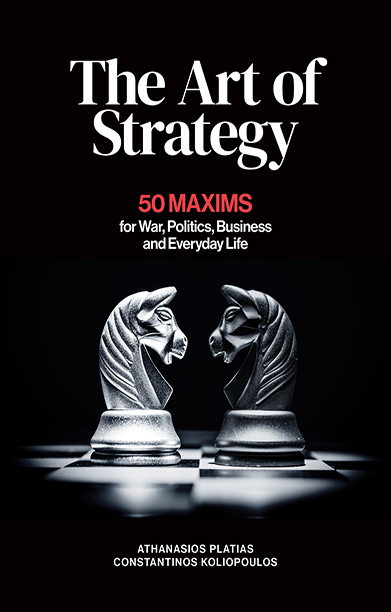
Athanasios Platias and Constantinos Koliopoulos, The Art of Strategy: 50 Maxims for War, Politics, Business and Everyday Life (London: Hurst & Company, 2026), 424 pp.
Athanasios Platias and Constantinos Koliopoulos’s The Art of Strategy: 50 Maxims for War, Politics, Business and Everyday Life is an ambitious effort to identify what is common to strategic behavior across widely different forms of human competition. The authors begin from a broad conception of strategy centered on the relationship between means and ends under conditions of actual or potential conflict. Although war and international politics provide many of their examples, their strategic universe extends considerably further, encompassing domestic politics, business, professional sports, games, and everyday life. Their purpose is correspondingly ambitious: the fifty maxims are intended not merely as individual pieces of strategic advice but, considered collectively, as the basis for a general theory of strategy.
I. Overview of the Book
The book is organized into four principal parts. The first addresses the general characteristics of strategy, beginning with the propositions that strategy is universal, that it can make the difference between victory and defeat, that there are no universally applicable formulas, that time matters at every level of strategy, and that strategy itself has limits. The second shifts the focus to the strategic actor operating within a competitive environment, examining preparation, power, organizational performance, leadership, strengths and weaknesses, geography, society and ideology, technology, intelligence, and efforts to shape the environment.
The third and largest part introduces the dynamic aspect of strategy that transforms it from a static calculation into an interactive actor-centered challenge. Questions concerning objectives and capabilities lead to Maxim 20, “The opponent has a strategy, too,” and Maxim 21, “Strategy must predict and adjust.” From there the treatment extends through crisis management, alliances, perception, prudence, war termination, third parties, rationality, and other dimensions of strategic interaction.
The final part turns principally to the execution of strategy, encompassing concentration, unity of command, friction, risk, different forms of conflict, battle, alternative strategies, the relationship between tactical success and strategic victory, deception, surprise, morale, logistics, exploitation, and strategic resilience. Its progression culminates in Maxim 50, which emphasizes the ability of strategic actors to sustain long-term competition.
Individual maxims receive substantive discussion rather than standing alone as aphorisms. Platias and Koliopoulos develop them through examples drawn from different historical periods and competitive activities, and important maxims frequently connect with others elsewhere in the work. Maxim 42, for example, explicitly develops ideas found in Maxims 3 and 21, while Maxim 50 connects resilience to preceding considerations including time, intelligence, adaptation, unity, and risk.
This interconnectedness is important because the authors do not expect the fifty propositions to operate independently. They acknowledge the possibility of overlap and tension among them and call for their critical, flexible, and combined application. Their approach should not, then, be reduced to fifty rules for winning. The Art of Strategy is intended to provide a framework through which readers may understand strategy, think strategically, and act strategically.
Taken on its own terms, the book therefore must be judged not merely as a collection of strategic maxims, but as a theory of strategy. That is a considerably more demanding claim.
Read the full article: https://mackinderforum.org/book-reviews/50-maxims-one-masterclass-in-strategic-thinking